
The route for alternative fuels is uncertain, and infrastructure is easily set in the wrong direction.
Complete English presentation of the source project analysis, preserving the full narrative, tables, figures and evidence boundaries.
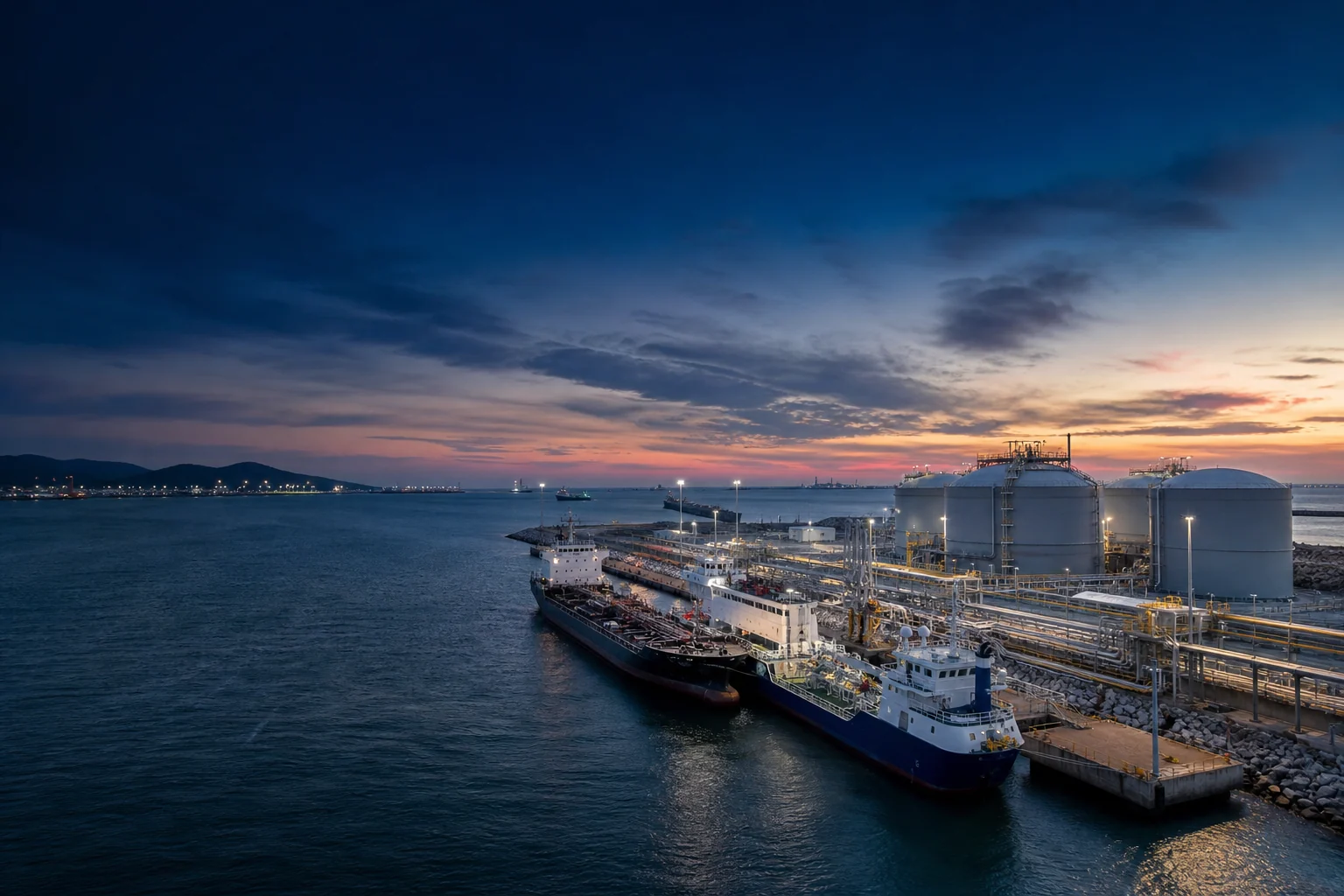
Maritime Energy Customer Case · Pain Point 7
The route for alternative fuels is uncertain, and infrastructure is easily set in the wrong direction.
Use scenario combinations, modular investments, and real options to control route risks
| Polaris Indicator Downside Scenario Risk-Adjusted NPV and Extended Option Value |
|---|
Executive Summary
This case revolves around 'uncertainty in alternative fuel routes and the risk of misaligned infrastructure,' using a real maritime energy business chain as a prototype. It covers inquiry, nomination, scheduling, delivery, measurement, sampling, quality, settlement, claims, and continuous improvement. The goal is to transform the uncertainties at ports and on vessels into measurable and controllable service capabilities.
| Business Profile | Case-based parameters |
|---|---|
| Select | LNG, biofuels, methanol, ammonia, shore power, and traditional fuels coexist |
| Uncertainty | Regulations, fuel availability, fleet orders, technological maturity and certification |
| Asset | Storage tanks, pipelines, barges, loading and unloading arms, safety zones, and training |
| Risk | Underutilization of large dedicated assets or outdated standards |
Failure signal
Predicting with a single benchmark instead of multiple scenarios
Treat fuel sales commitments as rigid demand
Ignore ship modification, certification, supply chain, and safety support
1. Representative Assignments/Transaction Examples
The following numbers are hypothetical professional cases used to illustrate economic and risk transmission, and do not represent the audit facts of any specific client.
Representative Economic/Operational Impact of This Pain Point
The source-document visual is presented here as an English-native analytical frame. The adjacent English narrative and tables preserve the full evidence and quantitative context.
| Project | Value/Impact | Explanation |
|---|---|---|
| Single Route CAPEX | 120 | One million dollars |
| NPV under low demand scenario | −38 | One million dollars |
| Modular Phase One | 42 | One million dollars |
| Expand options | +16 | Situational Value |
| Multi-fuel utilization rate | 68% | Target |
| Venture capital decline | 35% | Relative single rhyme |
2. Root Cause Analysis
Predicting with a single benchmark instead of multiple scenarios
Treat fuel sales commitments as rigid demand
Ignore ship modification, certification, supply chain, and safety support
Investment evaluation does not account for waiting, expansion, conversion, and exit options
Control Failure Chain
| Level | typical gap | Consequence |
|---|---|---|
| Business commitment | The quote/SLA does not reflect on-site constraints | Profits and services are inherently overestimated |
| Job execution | The event did not trigger reorganization, work stoppage, or escalation | Abnormal accumulation |
| Data evidence | Object, time, version, and signature are inconsistent | Unable to provide evidence |
| Organizational Governance | Cross-party responsibilities and the right to stop are unclear | Repeated failure |
3. Solution: Five-layer closed loop
| Hierarchy | Core Competence |
|---|---|
| 1 Fleet Demand Map | Modeling based on routes, vessel types, order books, and customer commitments |
| 2 Route Scenarios | Regulations/Price/Supply/Technology combination rather than a single point |
| 3 Investment Without Regret | Shared docks, utility tunnels, fire protection, digital, and training |
| 4 Modular Threshold | Phase according to committed volume, utilization rate, policy, and supply maturity |
| 5 Commercial Lock-in | Long-term exclusive distribution, minimum quantity, cost pass-through, and cooperative investment |
End-to-end operating mechanism
Ship/port/order events enter the unified voyage data mainline.
Feasibility, risks, economic impact, and evidence requirements of rule and model calculation services.
The person in charge shall carry out, stop, or escalate according to the authorization, and synchronize with the customer.
Delivery results, samples, measurements, costs, and claims are fed back to form a learning loop.
4. Implementation Roadmap
| Stage | Time | Delivery | Acceptance |
|---|---|---|---|
| Standardization | January–March | Caliber, SOP, Master Data, Responsibility Matrix | 20 assignments can be fully replayed |
| Visualization | March–June | Voyage/Order Control Tower, Exceptions and Evidence | Critical state T 0 |
| Intelligent | June–December | Prediction, Optimization, Risk Scoring, and Recommendations | Core KPI has entered the target range |
| Scaling | 12–18 months | Multi-port replication, supplier/customer collaboration | Standard coverage ≥90% |
The first 90 days
Select two core ports and one high-frequency fuel/service scenario.
Replay 20–30 normal, abnormal, and claim operations and establish a baseline.
First, verify the controllable loop manually, then gradually automate it.
Review false positives, missed alerts, adoption rate, economic value, and security impact every two weeks.
5. Outcome Indicators and Value
| Indicator | Baseline | 12-month goal |
|---|---|---|
| Lock demand coverage | 20% | ≥60% of initial production capacity |
| Initial CAPEX exposure | 120m | ≤50m |
| Multi-fuel compatible | Low | Core facility modularization |
| Decision Update | Annual | Quarterly event-driven |
| Downside scenario of asset utilization | 35% | ≥55% |
| Polaris Indicator Downside Scenario Risk-Adjusted NPV and Extended Option Value |
|---|
Value structure
Operational value: on time, full quantity, qualified, complete evidence.
Economic value: Reducing waiting, claims, rework, and leakage of funds and services.
Risk Value: Reducing high-consequence risks to safety, quality, compliance, and asset bets.
Customer Value: Provide consistent services that are commitable, explainable, and auditable.
6. AI Evolution and Control Boundaries
AI Applicability
Forecast fleet fuel demand range
Calculation Route Scenarios and Infrastructure Bottlenecks
Optimize the conditions for installment, expansion, and conversion triggers
Continuously monitor orders, policies, certifications, and supply
Control boundary
AI is responsible for extraction, correlation, prediction, and plan comparison, and does not replace the captain, on-site person in charge, inspector, or compliance officer.
All recommendations should display the data source, time, assumptions, confidence level, and failure conditions.
Safety/environmental red lines, legal requirements, and the finality rules of contracts must not be modified by the model on its own.
Automatically downgrade to manual operation in case of data interruption, significant changes, or model conflicts; retain the emergency stop authority.
7. Professional Conclusions and Next Steps
| Final judgment: Use scenario combinations, modular investment, and real options to control route risk. Only when the 'downside scenario risk-adjusted NPV and extended option value' consistently enter the target range, and no short-term profits are gained at the expense of safety, quality, compliance, or future options, is the capability truly replicable. |
|---|
Recommended next step
Conduct a 6-week diagnosis to create a list of events, losses, evidence, and control gaps.
Select a single-port/double-port pilot for 90 days to validate processes, data, and KPIs.
Include the final economic contribution together with safety, quality, and customer outcomes in performance.
After verification, copy according to port capacity tiers, rather than a simple 'one-size-fits-all' approach.
Applicable Caliber and Limitations
This report uses anonymized, case-based data. ISO 8217, MARPOL Annex VI, measurement standards, EU ETS, FuelEU Maritime, and port safety and environmental protection requirements should be based on the versions in effect for the applicable year and jurisdiction as agreed in the contract, and confirmed by qualified maritime, inspection, legal, compliance, or carbon professionals. This report does not constitute legal, classification, inspection, or regulatory advice.